 By admin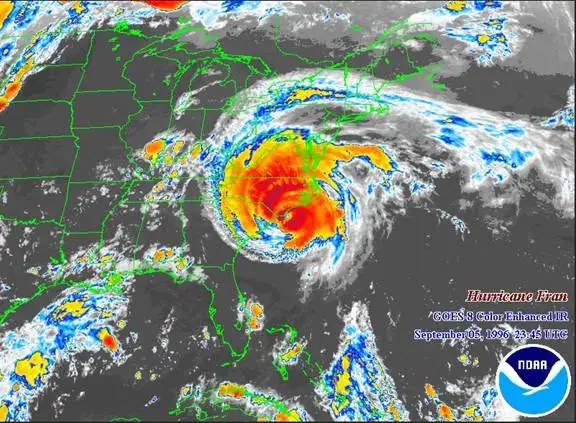
RALEIGH, N.C. (WNCN) — Thirty years ago this Saturday, Hurricane Fran roared ashore and began a destructive journey that would change the landscape of North Carolina from the coast to the capital in Raleigh and beyond.
Read more Aryna Sabalenka complains about the smell of marijuana during her US Open match
Fran made landfall around 8:30 p.m. Thursday, Sept. 5, 1996, just three days after Labor Day. The eye crossed the Cape Fear area in Brunswick County near Bald Head Island and Southport as a powerful Category 3 hurricane with 115 mph sustained winds.
Along the coast, Fran brought devastating wind and storm surge. Beaches still recovering from Hurricane Bertha, which struck North Carolina in the Wilmington area just two months earlier, were battered again.
Homes were damaged or destroyed, piers were ripped apart and entire coastal communities were left facing a massive cleanup.
Hurricane Fran then moved toward the Triangle. The center passed through Wake County overnight, with Raleigh-Durham International Airport recording a 79 mph wind gust. Fayetteville also recorded a 79 mph gust. RDU measured 8.80 inches of rain.
By sunrise Friday, Raleigh looked like a different city.
Thousands upon thousands of trees had fallen. Some snapped; others were ripped from rain-soaked ground by their roots. Trees crashed through homes, blocked streets and pulled down power lines.
NOW PLAYING
Almost all of Wake County lost electricity and nearly all of Raleigh’s traffic signals were reportedly out Friday morning.
Wake County’s population in 1996 was only about 549,000. Today, more than 1.25 million people call Wake County home, more than twice as many people as when Fran smashed directly through the county.
For many North Carolinians, the days after Fran became almost as memorable as the storm itself.
With power unavailable for days, and in some neighborhoods more than a week, refrigerators warmed, food spoiled and air conditioning disappeared just as September temperatures climbed back into the 90s.
Read more Parts of central NC under serve thunderstorm warning Friday
The scope of the damage to the electrical grid was staggering. About 4,000 power poles were snapped across North Carolina and roughly 1,000 miles of electrical distribution lines were down. At some point, 1.7 million North Carolina electric customers lost power.
NOW PLAYING
Ice suddenly became one of the hottest commodities in town.
Residents stood in long lines at stores that managed to open, hoping to find a few bags before supplies disappeared. Some families fired up backyard grills and cooked whatever meat was thawing in their freezers.
There was one unexpected consequence of the massive blackout: darkness.
NOW PLAYING
One Raleigh-area resident later recalled seeing the Milky Way from her own backyard for the first time because so much of the region had lost power. Another resident remembered the remarkable number of stars suddenly visible over a city that was normally illuminated at night.
Chainsaws became the soundtrack of September. Enormous piles of limbs and tree trunks appeared along streets and at temporary debris sites around the Triangle. In neighborhoods filled with snapped pine trees, the air carried the unmistakable scent of fresh pine, like Christmas in the middle of a hot North Carolina September.
Chainsaw accidents, falls, cuts, bites and stings, encounters with displaced snakes and other cleanup-related injuries became another concern as thousands of people ventured outside to clear trees and repair damage. Downed power lines and generators added still more dangers to a landscape already filled with hazards.
NOW PLAYING
The numbers remain staggering. Wake County alone suffered more than $900 million in residential and commercial property damage. Statewide, the damage to homes, businesses, agriculture, forests and infrastructure ran into the billions.
For a generation of North Carolinians, Hurricane Fran became the storm against which every hurricane since has been measured as one of North Carolina’s defining natural disasters — much like Hurricane Hugo was viewed in the Charlotte area.
The destruction was significant enough that its name was retired after the 1996 hurricane season. Fran will never again appear on an Atlantic hurricane list, with the name Fay taking its place when the list rotated again in 2002.
Fay is still on the names list and is back in the 2026 rotation as the sixth named storm this hurricane season.
Read more San Francisco 49ers arrive in Melbourne for historic NFL game against the LA Rams