 By admin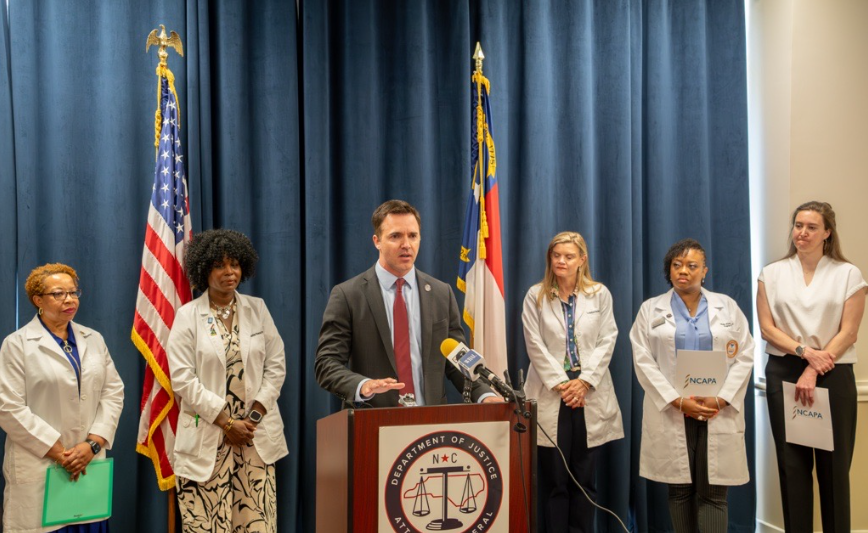
RALEIGH, N.C. (WNCN) — North Carolina has taken legal action against the United States Department of Education over a rule that will reduce how much healthcare workers can borrow in student loans, the attorney general’s office said Tuesday.
Read more Berlin OKs bid to rehost Olympics on or after 100th anniversary of 1936 Games under the Nazis
According to the Office of the North Carolina Attorney General, the rule will prevent nurses, physician assistants, physical therapists, occupational therapists, and audiologists from borrowing more than $20,500 a year in federal loans by narrowing the definition of a “professional” degree.
This amount of loans will not be enough to cover many healthcare programs, according to the attorney general’s office, including graduate nursing programs that are usually more than $30,000 annually without factoring in living expenses.

The rule is scheduled to take effect on July 1, according to the attorney general’s office.
The attorney general’s office argues the DOE rule is illegal because it is trying to rewrite Congress’ established definition of a professional degree.
Last year, according to the attorney general’s office, Congress passed a bill placing a limit on federal loans for graduate students at $20,500 annually and $100,000 total, while professional students would be able to receive $50,000 annually and $200,000 total in federal loans. Congress did not change the definition of professional degrees, which includes advanced-practice nurses and other healthcare providers.
Since the rule changes the bill’s definition of a professional degree, the attorney general’s office is arguing the DOE has violated federal law.
Read more NOAA releases annual hurricane outlook for 2026 season
The attorney general’s office noted the DOE rule will worsen healthcare conditions in North Carolina, where 93 of the 100 counties, including 54 of the 55 rural counties, already have a primary healthcare provider shortage that affects more than 2.3 million residents.

Among occupations considered not professional by the new rule are certified registered nurse anesthetists who deliver anesthesia in 80% of rural areas. Their job requires them to have a four-year college degree and complete a three-year doctoral program.
“This isn’t just about a worker shortage — it’s a respect shortage,” North Carolina Attorney General Jeff Jackson said in a statement. “Singling out nursing students and physician assistants for less financial aid is telling them the work they do isn’t important. That’s untrue and unfair. They are professionals under the law and we’re going to court to make sure the Department of Education treats them that way.”
The lawsuit was filed in the United States District Court of Maryland against the DOE and Education Secretary Linda McMahon.
North Carolina is joined the lawsuit by the attorneys general of Arizona, California, Colorado, Connecticut, Delaware, Hawaii, Illinois, Maine, Massachusetts, Maryland, Michigan, Minnesota, Nevada, New Jersey, New Mexico, New York, Oregon, Rhode Island, Vermont, Virginia, Washington, Wisconsin, and Washington, D.C. and the governors of Kentucky and Pennsylvania.
Read more 2-time NASCAR champion Kyle Busch hospitalized with severe illness, family says
The full lawsuit can be viewed below.