 By admin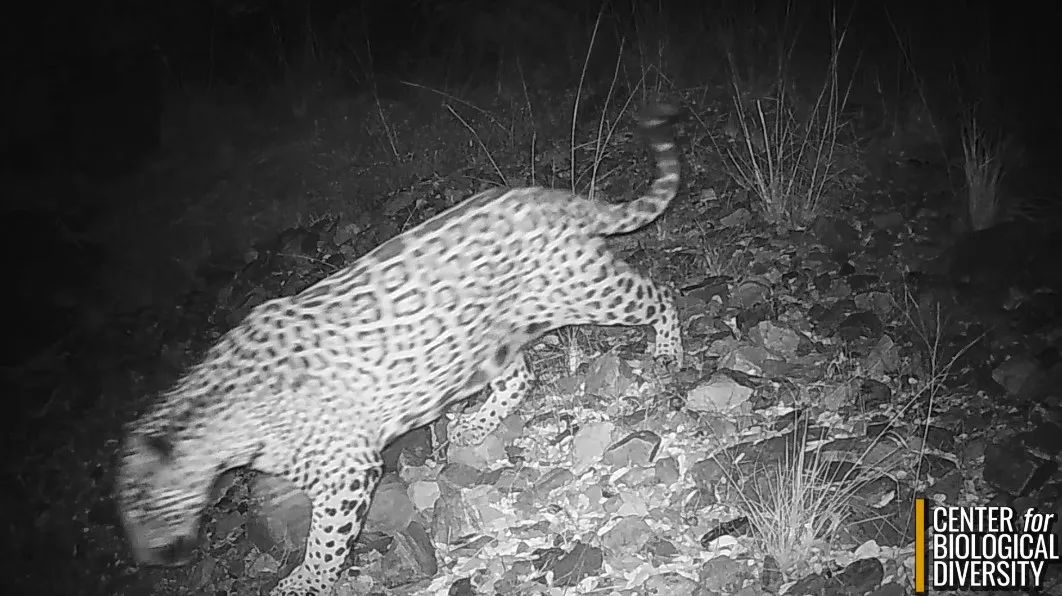
McALLEN, Texas (Border Report) — Remote wildlife cameras recently captured a rare and endangered jaguar crossing the Arizona borderlands.
The video was taken by the Center for Biological Diversity in Arizona’s Madrean Sky Islands, which are isolated mountain ranges in the southeastern part of the state bordering Mexico.
The wildlife nonprofit conservation organization, which released the video on Tuesday, says it’s important to show proof of jaguars and other endangered majestic creatures living in an area where border wall is planned.
“Seeing this incredible jaguar roaming in Arizona’s wild sky islands is a powerful reminder that these cats belong in the American Southwest and northern Mexico,” said Russ McSpadden, Southwest conservation advocate at the Center for Biological Diversity.
The mountain are nicknamed “islands” because they rise so high and quickly from a desert base, that multiple habitats can be found from base to peak, according to Arizona State Parks.
But McSpadden says border wall construction slated for the entire region threatens the few remaining jaguars living there.
“Tragically, jaguars’ northern range is being ripped apart by Trump’s border wall construction, along with mining, groundwater depletion and climate-driven drought. We need to take urgent action to protect our vital cross-border ecosystems so jaguars can continue prowling the southern Arizona landscape alongside bears, pumas and ringtails. A landscape this wild is too precious to sacrifice.”
Read more Caterpillar adding 600 jobs at Lee County plant near Sanford to build compact track loaders
The Trump administration currently is constructing 583 miles of primary, secondary, waterborne and “smart wall” border barrier across the Southwest border, including through Arizona. The agency has awarded contracts for 950 miles of border barriers, which are in the design phase, and has 324 more miles of planned barriers that have not been awarded, the agency said Monday.

The Center for Biological Diversity says the video was captured by remote wildlife cameras recorded in March and April 2026. It shows a large adult male jaguar, which was nicknamed “Cinco” by the Wild Cat Research and Conservation Center in 2025 after it became the fifth jaguar documented through the group’s monitoring efforts in the region.
Jaguars are endangered in the United States and Mexico. At least nine jaguars have been seen in the Southwest since 1996.
The jaguar has the strongest bite of all the felines, and are the third-largest cat in the world, with most weighing between 150 pounds and 250 pounds. They’re strong swimmers and climbers and need vast amounts of territory for survival, according to the World Wildlife Fund.
The Center for Biological Diversity says future jaguar species depends on cross-border conservation efforts among governments, Tribal Nations, local communities and conservation groups to protect habitat, restore wildlife corridors and safeguard the interconnected ecosystems and Indigenous lands these cats have relied on for generations.
“I have prayed for the return of jaguars to these mountains, part of the ancestral lands of the O’odham,” Austin Nunez, chairman of the San Xavier District of the Tohono O’odham Nation, said in a statement. “Jaguars are protectors of the people and are a part of our spiritual life and our connection to this land. Seeing a jaguar still moving through these mountains gives me hope for future generations and reminds us of our responsibility to protect these majestic animals and the places they depend on.”
Read more North Carolina budget framework reshapes future income tax cuts
Sandra Sanchez can be reached at [email protected].